A guided case for the historical Jesus, built from secular sources, eyewitness claims, and ancient predictions.
Skeptic's Note: Doubt is not the enemy of faith. It can be the doorway to real conviction when the evidence is examined honestly.
1. The Core Question
The first question is simple: did Jesus of Nazareth exist as a real person in history? The second question goes further: if He did, was He who He claimed to be?
This guide follows the evidence in three steps: non-Christian sources that mention Jesus and early Christians, the behavior of people who claimed to see Him alive, and the Bible's pattern of ancient predictions and fulfillment.
Prefer to Watch?
This video walks through the same case for people who prefer to listen and watch before reading the evidence below.
The New Testament is not the only place Jesus appears. Several non-Christian writers, including hostile or unsympathetic witnesses, give us a basic outline: Jesus was known, He was executed under Pontius Pilate, His followers worshiped Him, and the movement spread quickly.
Tacitus Hostile
Roman Historian (AD 56-120) Writing about Nero's persecution of Christians, Tacitus places Jesus' execution during the reign of Tiberius and under Pontius Pilate.
Read Text
Josephus Jewish
Jewish Historian (AD 37-100) Josephus identifies Jesus as a wise man, notes that He was called the Christ, and names James as His brother.
Read Text
The Talmud Hostile
Rabbinical Writings (AD 70-200) The Talmud remembers Jesus, called "Yeshu," as being executed on Passover eve and explains His works as "sorcery" rather than denying that they were reported.
Read Text
Pliny the Younger Hostile
Roman Governor (AD 61-113) Pliny reports to Emperor Trajan that Christians met before dawn and sang hymns to Christ "as to a god," showing early worship of Jesus as divine.
Read Text
Suetonius Hostile
Roman Historian (AD 69-122) Suetonius mentions disturbances in Rome connected with "Chrestus," a name many scholars connect with disputes over Christ among Roman Jews.
Read Text
Thallus Skeptic
Historian (AD 52) According to Julius Africanus, Thallus tried to explain the darkness at the crucifixion as a solar eclipse, even though Passover occurs at a full moon.
Read Text
3. The Eyewitnesses
Christianity stands or falls on the claim that Jesus rose from the dead. One major line of evidence is not only what the first witnesses said, but what they were willing to suffer after saying it.
The Logic: Martyrdom does not automatically prove a belief is true, but it does tell us something about sincerity. Liars usually lie to gain money, sex, or power. The disciples gained poverty, torture, and death. People may die for what they believe is true, but they do not willingly die for what they know is a lie.
Tap a person to see their file:
PeterThe Fisherman
James (Zebedee)The Close Friend
James (Brother)The Family Skeptic
ThomasThe Doubter
AndrewThe Missionary
PaulThe Enemy
What this section shows
Taken together, these witnesses form a pattern: frightened followers, a skeptical family member, and even a former enemy all became convinced that Jesus was alive. Their courage does not prove every detail by itself, but it strongly suggests they were not protecting a story they knew was false.
4. Predicted Beforehand: The Messiah
The word Messiah means the promised rescuer and King God said He would send. Long before Jesus was born, the Old Testament gave a pattern of details about that coming person.
The point is not that Jesus matched one vague sentence. The point is that many details, written long in advance, line up around one person.
The simple argument
1God says He can announce future events before they happen, so people can recognize His hand when they come true.
2The Old Testament writings existed before Jesus, so these predictions were not invented after His life.
3Jesus fits details no ordinary person could arrange for themselves: birthplace, family line, rejection, betrayal price, suffering, and burial.
Why prediction matters
God presents foretelling the future as one way to recognize that He is God. He can say what will happen before it happens, so that when it comes true, people can know it was not coincidence, human guessing, or another god.
Read Isaiah 46:9-10Read Isaiah 48:5
Were these texts really written first?
This is the first thing to check. A prediction only counts as evidence if it came before the event. Two major manuscript facts matter here:
The Septuagint (250 BC): The Old Testament was translated into Greek in Egypt roughly 250 years before Jesus was born, and that translation circulated widely.
Dead Sea Scrolls (150 BC): Discovered in 1947, these manuscripts, including a complete copy of Isaiah, have been dated to at least a century before Jesus. They closely match the biblical text we have today.
Now follow the timeline. The date label shows roughly when the prediction was written, not when Jesus lived. Each item explains the Gospel event first, then the older text, then why the match matters. Tap Time Gap to feel how long before Jesus these words were written.
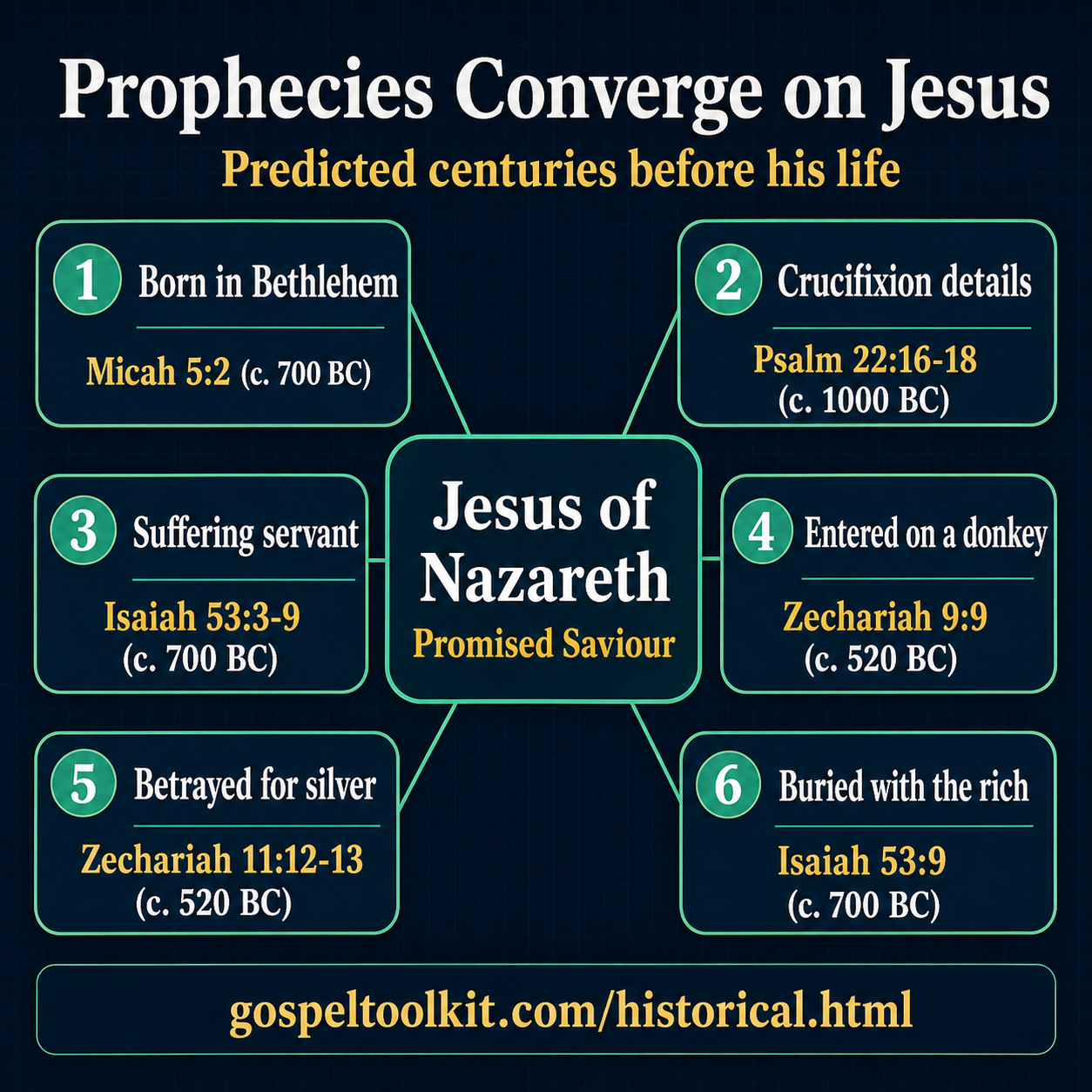
Infographic: How the predictions converge
Each prediction narrows the field. One detail points to a region, another to a family line, another to rejection, suffering, betrayal, and burial. Together they form a profile that Christians believe converges on Jesus of Nazareth.
What happened to Jesus
Jesus was crucified. The New Testament describes His hands and feet being wounded, and Thomas later speaks of the nail marks in His hands.
What the older text said
Psalm 22 describes a suffering person whose hands and feet are pierced.
Why this matters
This was written about 1,000 years earlier and long before crucifixion became a common Roman execution method. Jesus could not control the method chosen by His enemies.
PredictionJesus Story
Predicted around 1000 BC - Rejection
Rejected by the Leaders
What happened to Jesus
Many of the religious leaders rejected Jesus, opposed His teaching, and helped bring Him before the Roman authorities.
What the older text said
Psalm 118 says the stone rejected by the builders would become the cornerstone.
Why this matters
A reader might expect the Messiah to be welcomed by the religious establishment. This text prepares for the opposite: rejection first, then vindication.
PredictionJesus Story
Predicted around 750 BC - Childhood in Egypt
Called Out of Egypt
What happened to Jesus
Matthew says Joseph took Mary and the young Jesus to Egypt to escape King Herod, then later brought Him back.
What the older text said
Hosea says, "Out of Egypt I called my son." The New Testament reads this as Jesus reliving Israel's story.
Why this matters
This is a childhood event outside Jesus' control. It presents Jesus as the true Son who carries Israel's story forward.
PredictionFulfillment
Predicted around 740 BC - Miraculous birth
Born of a Virgin
What happened to Jesus
Matthew and Luke present Jesus' birth as miraculous, not the result of an ordinary human father.
What the older text said
Isaiah speaks of a virgin conceiving and bearing a son called Immanuel, meaning "God with us."
Why this matters
The birth of the Messiah is described as a sign from God. It points beyond an ordinary political leader.
PredictionJesus Story
Predicted around 740 BC - Suffering servant
The Suffering Servant
What happened to Jesus
Jesus was beaten, condemned, executed, and did not defend Himself with force. Christians understand His death as bearing sin for others.
What the older text said
Isaiah 53 describes a servant who is pierced, suffers for others, remains silent before accusers, and is connected with both death and healing.
Why this matters
This gathers several details into one portrait. The Dead Sea Scrolls are important because they show Isaiah existed before Jesus.
Read Verse 5Jesus Story
Predicted around 700 BC - Messenger first
A Messenger Prepares the Way
What happened to Jesus
Before Jesus began His public ministry, John the Baptist called people to repent and pointed them toward Jesus.
What the older text said
Isaiah speaks of a voice in the wilderness preparing the way of the Lord.
Why this matters
Important kings were announced before they arrived. The Messiah is also introduced by a messenger before His public work begins.
PredictionJesus Story
Predicted around 700 BC - Birthplace
Born in Bethlehem
What happened to Jesus
The New Testament says Jesus was born in Bethlehem, though He grew up in Nazareth and was later known as Jesus of Nazareth.
What the older text said
Micah says a ruler for Israel would come from Bethlehem.
Why this matters
Birthplace is not something a person can arrange for themselves. This is a specific location, not a vague spiritual idea.
PredictionFulfillment
Predicted around 520 BC - Jerusalem entry
Riding on a Donkey
What happened to Jesus
Near the end of His ministry, Jesus entered Jerusalem riding on a donkey while crowds welcomed Him.
What the older text said
Zechariah says Zion's king would come humbly, mounted on a donkey.
Why this matters
A conquering king normally rode a horse. This picture identifies a different kind of King: humble and peaceful.
PredictionJesus Story
Predicted around 520 BC - Betrayal price
Sold for 30 Silver Coins
What happened to Jesus
Judas, one of Jesus' own disciples, agreed to betray Him to the chief priests for thirty pieces of silver.
What the older text said
Zechariah names thirty pieces of silver as the weighed-out price.
Why this matters
This is unusually specific. It gives not only betrayal, but a precise amount of money connected to the event.
PredictionJesus Story
What this section shows
The evidence is cumulative. One prediction might be easy to dismiss, but a pattern written centuries beforehand is harder to ignore. If God said He would identify the Messiah in advance, and Jesus fits that pattern, then the predictions become a serious reason to consider that Jesus is the Messiah.
Tap any row to compare an ancient prediction with the New Testament fulfillment. These are additional texts many theologians connect with the promised Messiah.
Prediction / Date
Fulfillment & Significance
Gen 3:15 (c. 1400 BC)
Seed of the Woman
Born of a woman, with an implication later connected to the virgin birth. Presented as the first messianic prediction in the Bible.
Gen 49:10 (c. 1400 BC)
Tribe of Judah
The promised ruler comes through Judah. Narrows the lineage to one of Israel's twelve tribes.
Isaiah 7:14 (700 BC)
Born of a Virgin
A miraculous conception. A sign to the house of David.
Jeremiah 31:15 (600 BC)
Slaughter of Innocents
Herod's killing of the children in Bethlehem. A historical tragedy surrounding Jesus' birth.
Isaiah 9:1-2 (700 BC)
Ministry in Galilee
Ministry in Galilee, described as light reaching the nations. Points to a specific region of ministry.
Psalm 78:2 (1000 BC)
Teaching in Parables
Teaching through parables, stories, and riddles. Highlights a distinctive teaching style.
Psalm 41:9 (1000 BC)
Betrayed by a Friend
Betrayal by a close companion. "He who ate my bread has lifted his heel."
Isaiah 53:7 (700 BC)
Silent Before Accusers
Refusal to defend Himself before accusers. Striking because silence is unusual when facing judgment.
Psalm 22:18 (1000 BC)
Casting Lots for Clothes
Soldiers casting lots for His clothing. Specific detail of Roman execution.
Psalm 34:20 (1000 BC)
No Bones Broken
Jesus' legs were not broken on the cross. Passover lambs also could not have broken bones.
Zechariah 12:10 (520 BC)
Pierced Side
A spear pierced His side after death. Connected with the phrase "look on me whom they pierced."
Isaiah 53:9 (700 BC)
Buried with the Rich
Buried in a rich man's tomb. Executed criminals were usually thrown in pits.
The Statistical Improbability
The "Fingerprint" Problem
The timeline above highlights only a few key predictions. Many scholars and theologians identify over 300 specific details and implications in the Old Testament that point to the promised Messiah and are understood by Christians as fulfilled in Jesus.
Why this is strong evidence:
Time Gap: These documents, including the Dead Sea Scrolls, physically existed centuries before Jesus was born.
Lack of Control: A person cannot arrange their own birthplace, ancestry, betrayal price, or the way soldiers gamble for their clothes.
Mathematicians have calculated the odds of one person fulfilling just 8 of these predictions by chance with a famous illustration: cover the entire state of Texas in silver dollars two feet deep, mark one coin, blindfold a person, and ask them to pick the marked coin on the first try. The odds for fulfilling 300+ are described as astronomical.
Where the Evidence Leads
This page has followed three lines of evidence, and each one adds something different to the case for Jesus.
The secular record shows that Jesus was not invented by later Christians. Non-Christian sources remember Him, His execution, and the early movement that worshiped Him.
The eyewitnesses show that the first believers were not casually repeating a rumor. They suffered for the claim that Jesus had risen.
The ancient predictions show a pattern written before Jesus: the Messiah would be rejected, suffer, die, and still be God's promised King.
The conclusion is not that one isolated fact proves everything. The strength is the way the evidence comes together. Jesus appears in history, His followers were convinced He rose, and His life matches the pattern God gave beforehand. Taken together, this gives a serious reason to believe Jesus is the promised Saviour.